

Choose iron infusion when confirmed iron deficiency does not improve with oral treatment, pills cause unacceptable side effects, or intestinal absorption is impaired; choose oral iron when you can absorb and tolerate it and your condition allows gradual replacement. This 2026 guide compares iron infusion vs oral iron by treatment response, safety, convenience, and the medical findings that determine your next step.
TL;DR
- Iron infusion vs oral iron is a choice about absorption, tolerability, and urgency—not a universally better treatment.
- Oral iron suits stable patients who absorb and tolerate supplements; IV iron bypasses intestinal absorption.
- Persistent iron deficiency needs investigation for blood loss or poor absorption, whichever treatment you receive.
- Infusion Center of NJ provides physician-led iron infusion services in Clifton and Tenafly.
Why this matters in 2026
Fatigue alone does not establish iron deficiency. Before choosing a treatment, you need laboratory findings and a clinical assessment that explain whether iron is low, whether anemia is present, and why the problem developed.
Iron infusion treats iron deficiency; it is not a general-purpose energy treatment. Infusion Center of NJ provides physician-led IV therapy, including iron infusions, but the treatment route should follow your medical findings rather than your preference for pills or an IV.
Low iron can reflect inadequate intake, blood loss, or impaired absorption. Replacing iron without investigating the cause leaves an important part of treatment unfinished.
At a glance: iron infusion vs oral iron
| Dimension | Iron infusion | Oral iron |
|---|---|---|
| Best for | Confirmed deficiency with intolerance, inadequate response, impaired absorption, or a clinical need for faster replacement | Stable patients who can absorb and tolerate oral treatment |
| Absorption: standout feature | Delivers iron into the bloodstream, bypassing the intestine | Depends on intestinal absorption |
| Treatment response | Replaces iron more directly; blood-cell production still takes time | Gradual replacement that depends on absorption and adherence |
| Tolerability | Avoids oral gastrointestinal exposure; introduces infusion-related risks | Can cause nausea, constipation, abdominal discomfort, and dark stools |
| Convenience | Requires clinical appointments and monitoring | Taken at home, with attention to dosing and interactions |
| Monitoring | Needs laboratory follow-up and clinical assessment | Needs laboratory follow-up and clinical assessment |
| Underlying cause | Does not stop bleeding or correct every cause of deficiency | Does not stop bleeding or correct every cause of deficiency |
| Billing model | Medication, administration, and clinical-service components | Supplement or prescription expense, plus evaluation and follow-up |
Oral iron is the better starting point when absorption is adequate
Best for: stable patients with confirmed deficiency who can tolerate and absorb oral treatment. Oral iron avoids an IV procedure and allows treatment at home. Its limitation is that swallowing a supplement does not guarantee that enough iron reaches your circulation.
Your clinician should distinguish an unsuccessful treatment from an incomplete trial. Missed doses, side effects, interactions, continued bleeding, and an unsuitable schedule can all interfere with the result.
The American Gastroenterological Association’s clinical practice update on iron-deficiency anemia advises oral iron no more than once daily; every-other-day dosing can improve tolerability for some patients. That is a reason to review the schedule with your clinician, not to increase or rearrange treatment yourself.
Bring the supplement packaging to your appointment. The amount of elemental iron matters more than the total weight of the iron compound printed on the label.
IV iron wins when intestinal absorption is the obstacle
Best for: patients whose confirmed deficiency cannot be adequately corrected through the digestive tract. IV iron bypasses intestinal absorption. This is its clearest advantage over tablets, rather than a promise that every patient will feel better immediately.
Conditions affecting the intestine, certain gastrointestinal operations, and inflammation can make oral replacement less effective. A diagnosis alone does not automatically settle the route; your laboratory results, previous treatment, and current clinical needs still matter.
For a treatment decision in 2026, ask your clinician to separate these possible explanations:
- Poor tolerance: side effects prevent you from taking the prescribed treatment.
- Poor absorption: the intestine does not absorb enough iron despite an appropriate trial.
- Ongoing loss: bleeding continues faster than treatment replaces iron.
- Another diagnosis: iron deficiency does not fully explain the anemia or symptoms.
These problems require different responses. Changing the route can address absorption, but it cannot substitute for investigating bleeding or another cause of anemia.
!Treatment review connects poor tolerance, poor absorption, ongoing loss, and another diagnosis.
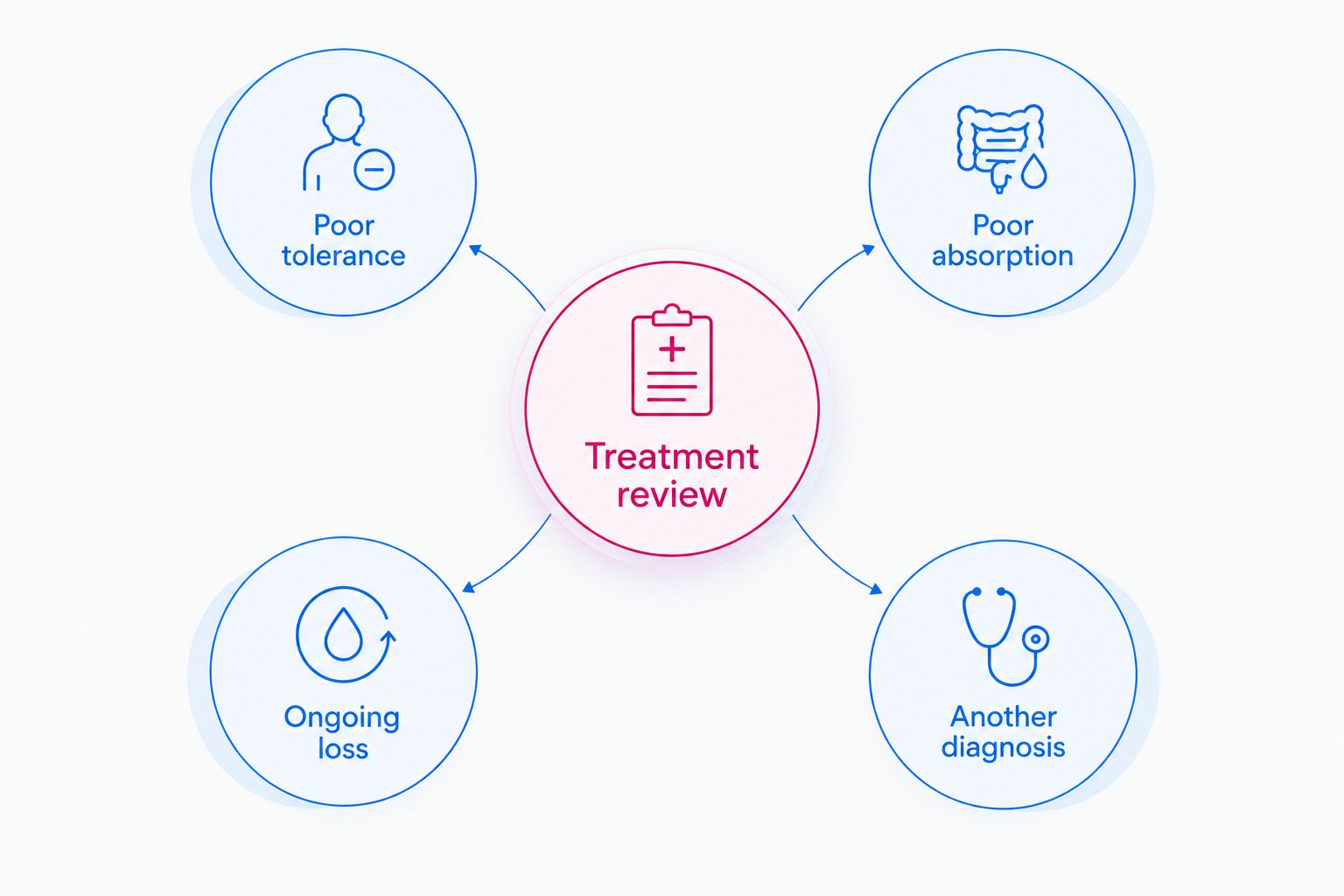
An unsuccessful course of oral iron needs an explanation before the next treatment is selected.
IV iron replaces iron more directly, not symptoms instantly
IV iron delivers the prescribed iron without relying on intestinal absorption. Your bone marrow still needs time to produce additional red blood cells, and symptoms do not necessarily change on the day of treatment.
Oral treatment needs an agreed checkpoint rather than an open-ended instruction to keep taking pills. The British Society of Gastroenterology guideline on adult iron-deficiency anemia identifies a hemoglobin rise of at least 10 g/L within 2 weeks as a good response to iron therapy. That equals 1 g/dL; it is a clinical response benchmark, not a guarantee for every patient.
Your clinician should interpret that response alongside your starting hemoglobin, treatment schedule, bleeding history, and other conditions. A smaller rise warrants reassessment rather than an automatic conclusion that an infusion is necessary.
Judge treatment by the planned laboratory response and your clinical condition—not by a promised energy boost. Hemoglobin improvement and restoration of iron stores are related but separate treatment goals.
Neither route wins on safety for every patient
Oral iron commonly causes gastrointestinal side effects, including nausea, constipation, abdominal discomfort, and dark stools. These effects can make an otherwise suitable treatment difficult to continue.
IV iron avoids exposure of the digestive tract to an oral iron dose, but it introduces different risks. Infusion reactions can occur, and some formulations are associated with low phosphate levels. Iron leaking outside the vein can also cause persistent skin staining.
Severe allergic reactions are uncommon, but an infusion still belongs in a clinical setting prepared to recognize and manage reactions. Tell the treating team about previous iron treatments, allergies, and any reaction you experienced.
Ask which formulation is proposed, what symptoms to report, and whether your medical history calls for phosphate testing. A treatment that avoids constipation is not automatically the safest treatment for your circumstances.
Oral iron wins on home convenience; IV needs appointment planning
Oral iron usually fits more easily around work and caregiving because you take it at home. The tradeoff is repeated dosing, remembering the schedule, and managing interactions with food, supplements, or medicines.
IV iron requires travel and time in a clinical setting. The formulation and prescribed replacement plan determine the appointment schedule; do not assume every infusion follows the same timing or completes treatment in one visit.
Before choosing a route, ask:
- Can you reliably follow the oral schedule without unacceptable symptoms?
- Do your medicines require separation from oral iron?
- Can you attend the proposed infusion appointments and follow-up testing?
- Who will review the results and decide whether treatment is complete?
Infusion Center of NJ offers iron infusion services in Clifton and Tenafly. Confirm the proposed schedule directly rather than planning around another patient’s experience.
Both routes need laboratory follow-up
Neither iron infusion nor oral iron is a “treat once and forget it” approach. Follow-up should establish whether anemia is improving, iron stores are recovering, and continued loss is undermining treatment.
A complete blood count, ferritin, and transferrin saturation help clinicians assess different parts of the picture. Ferritin also rises with inflammation, so a result within a laboratory’s reference range does not always exclude deficiency.
For your 2026 treatment plan, leave the appointment knowing which tests are needed, when they should be repeated, and who will explain them. Testing immediately after IV iron can complicate interpretation of iron measurements; use the timing your clinician specifies.
If several clinicians are involved, share the treatment details and laboratory plan. This guide to explaining your IV therapy plan to your primary care doctor can help you organize that discussion.
Neither route fixes the reason you are losing iron
Iron replacement and investigation should proceed as connected parts of care. An infusion can replenish iron without stopping heavy menstrual bleeding, gastrointestinal bleeding, or another continuing source of loss.
Your age, menstrual history, digestive symptoms, diet, medications, and previous investigations help determine the next steps. Do not assume a restrictive diet explains every low result, and do not assume the absence of stomach pain excludes gastrointestinal disease.
New iron-deficiency anemia in an adult needs a medical explanation. The appropriate investigation differs by clinical history; it is not the same checklist for every patient.
Seek urgent medical assessment for chest pain, fainting, severe breathlessness, vomiting blood, or suspected significant bleeding. A routine infusion appointment is not a substitute for emergency assessment, and IV iron is not the same treatment as a blood transfusion.
Pricing models: compare the whole treatment pathway
The practical comparison in 2026 is between two care pathways, not simply a bottle of tablets and an infusion bag. Oral treatment includes the medicine, clinical evaluation, laboratory monitoring, and any further assessment needed when the response is inadequate.
IV treatment can involve separate medication, administration, facility, and professional-service billing components. Insurance coverage and authorization requirements depend on your plan and the clinical circumstances; neither route should be described as automatically covered.
Before proceeding, request clarification on:
- Which services are included in the proposed treatment arrangement.
- Whether the plan requires authorization or documentation of prior oral treatment.
- Whether laboratory testing is billed separately.
- Who handles questions about coverage and patient responsibility.
Do not choose an infusion solely to avoid another supplement purchase. Choose the medically appropriate route, then clarify the financial arrangements before treatment.
Final verdict: match the route to the barrier
Choose iron infusion if oral replacement cannot meet your needs
Named winner: IV iron for patients with documented intolerance, inadequate response, impaired absorption, or a clinical need for faster iron replacement. The decision should include the proposed formulation, monitoring plan, and investigation of the deficiency’s cause.
Infusion Center of NJ is an option for physician-led iron infusion care in Clifton and Tenafly. Use a clinical discussion to establish suitability rather than treating IV delivery as an upgrade everyone needs.
Choose oral iron if you can absorb and tolerate treatment
Named winner: oral iron for stable patients who can follow treatment and demonstrate an appropriate response. Ask for a defined laboratory checkpoint and a clear plan if side effects or poor response interrupt treatment.
| Dimension | Winner |
|---|---|
| Starting treatment when absorption and tolerance are adequate | Oral iron |
| Bypassing impaired intestinal absorption | IV iron |
| Delivering iron without gastrointestinal absorption delays | IV iron |
| Avoiding oral gastrointestinal side effects | IV iron, with different risks to assess |
| Home convenience | Oral iron |
| Need for laboratory monitoring | Tie |
| Need to investigate the cause | Tie |
| Billing simplicity | Oral iron generally has fewer administration components |
FAQ
Is an iron infusion better than oral iron?
Iron infusion is better when oral iron is not tolerated, is not absorbed adequately, fails to improve iron stores, or cannot meet the clinical need for replacement. Oral iron remains an appropriate option for stable patients who absorb it and respond to treatment.
How do I know whether iron pills are working?
Follow-up blood tests establish whether iron pills are working. Your clinician compares hemoglobin and iron measurements with your starting results and interprets them alongside symptoms, adherence, and ongoing blood loss.
Should I stop iron pills if they cause constipation?
Contact your prescribing clinician if constipation makes oral iron difficult to continue. A review of the formulation or schedule can help determine whether oral treatment remains suitable or IV iron should be considered.
Will an iron infusion give me energy immediately?
An iron infusion does not guarantee immediate improvement in energy. Iron delivery occurs during treatment, but red blood-cell production and symptom improvement take time, and fatigue can have causes unrelated to iron deficiency.
Can I get an iron infusion without anemia?
Iron deficiency can exist without anemia, but that does not automatically make an infusion appropriate. Your clinician should assess iron studies, symptoms, the cause of deficiency, and whether oral replacement is suitable.
Is IV iron the same as a vitamin drip?
IV iron is a medication treatment for iron replacement, not a general vitamin or hydration infusion. It requires an appropriate diagnosis, formulation selection, and clinical monitoring.
What should I bring to an iron treatment consultation in 2026?
Bring recent blood results, your medication and supplement list, and details of previous oral or IV iron treatment. Include the oral product, schedule, side effects, and any history of bleeding or gastrointestinal surgery.
One last thing
A hemoglobin result returning to the reference range does not necessarily mean your iron stores are fully replenished. Ask what defines completion of treatment—not just what defines improvement.
That question gives you a clearer endpoint for either route and helps prevent stopping treatment without an agreed follow-up plan.