
Iron infusion cost in 2026 splits into two very different numbers depending on where you sit for the drip. Choose a physician-led, self-pay clinic like Infusion Center of NJ if you want one flat per-visit price and a same-week appointment; choose a hospital-based infusion center if your insurance plan requires a hospital outpatient setting because of complex comorbidities. The real variable isn't the iron formulation your doctor orders — it's the building you sit in while it's administered.
TL;DR
- Iron infusion cost in 2026 depends more on setting than formulation: self-pay clinics quote one flat rate, hospitals bill drug charge plus a separate facility fee.
- Infusion Center of NJ runs a self-pay model with no referral required and same-week scheduling in Clifton and Tenafly, NJ.
- Hospital-based infusion centers often require prior authorization and a physician referral, adding weeks to the wait.
- Facility fees at hospital outpatient departments are a documented, separate line item that self-pay clinics don't charge.
- Insurance breadth favors hospitals for complex cases; pricing transparency favors self-pay clinics for straightforward iron deficiency.
Why this matters
Iron deficiency anemia is one of the most common reasons a primary care doctor orders IV iron instead of oral supplements, usually because oral iron hasn't worked or isn't tolerated. The clinical drug cost is only one piece of the iron infusion cost equation in 2026 — the setting you're treated in changes the bill as much as the dose does.
Patients comparing options usually land on two models: a self-pay, physician-led outpatient clinic, or a hospital outpatient infusion department billed through insurance. Both can deliver the same IV iron formulation competently. The difference is how the bill is structured and how fast you get a chair.
The Infusion Center of NJ runs on the first model at its Clifton and Tenafly locations. This comparison breaks down where each model wins, where they tie, and which one fits your situation in 2026.
At a glance: self-pay clinic vs. hospital-based infusion center
| Dimension | Infusion Center of NJ | Hospital-Based Infusion Center |
|---|---|---|
| Best for | Diagnosed iron deficiency wanting same-week, self-pay care | Complex comorbidities needing hospital-level monitoring |
| Pricing model | Flat self-pay rate quoted per visit | Drug charge plus separate facility fee, billed to insurance |
| Standout feature | Physician-led outpatient suite, no referral required | On-site hospital emergency backup and broad specialist access |
| Referral requirement | Not required for self-pay visits | Usually requires a referral and prior authorization |
| Scheduling speed | Same-week appointments are typical | Often weeks of delay while prior auth clears |
| Facility fees | None — the quoted rate is the total cost | Charged separately from the iron infusion itself |
| Setting | Private outpatient suite | Hospital outpatient infusion unit |
| Physician oversight | Board-certified physician-led | Physician-staffed, hospital protocol-driven |
| Insurance coverage breadth | Out-of-network for most plans by design | Broad in-network coverage under major medical plans |
!Two-column diagram comparing self-pay clinic costs and hospital-based infusion center costs
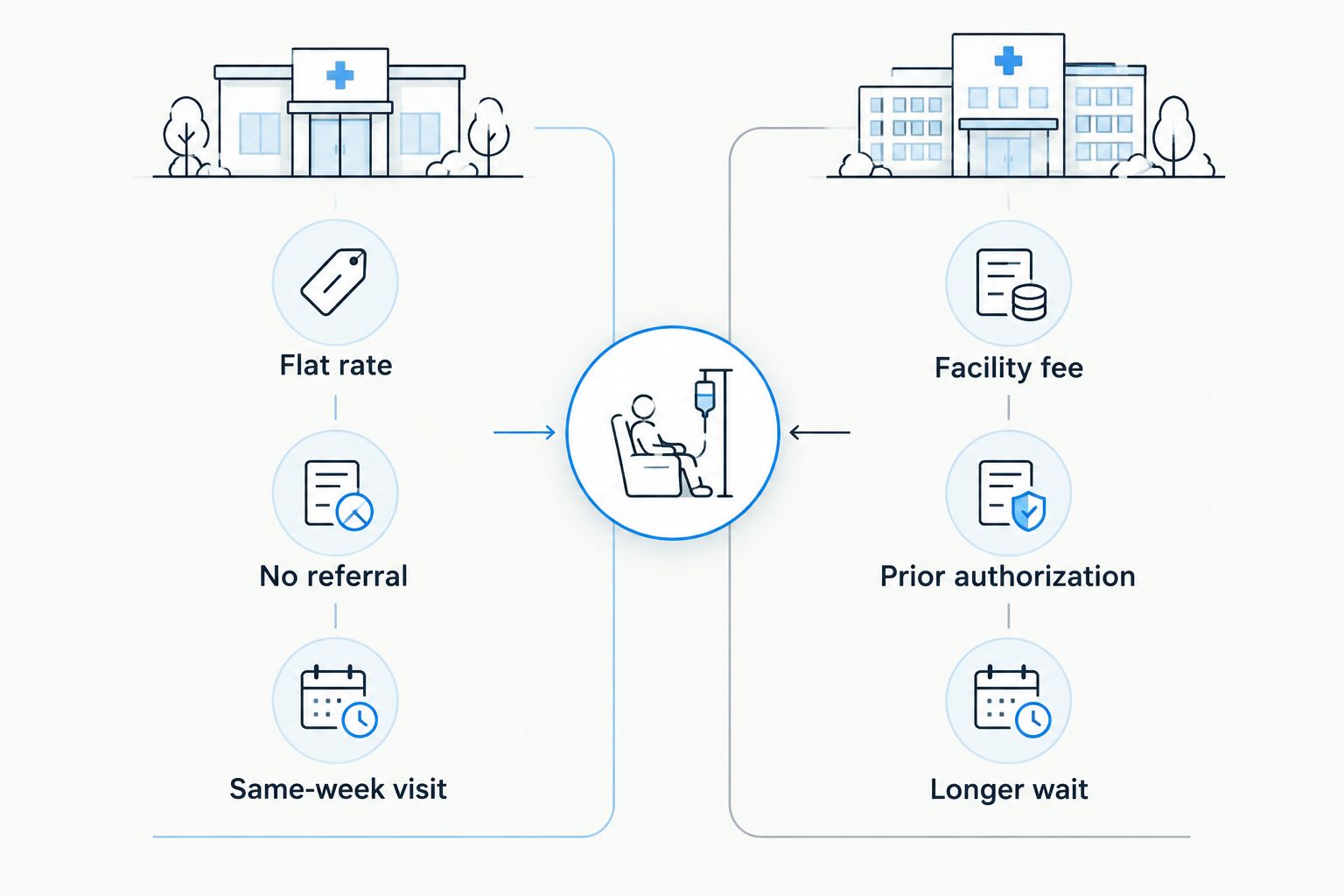
The cost gap comes from billing structure, not the iron drug itself.
Infusion Center of NJ schedules faster — no referral required
A self-pay model removes the step that slows hospital infusion down the most: prior authorization. Patients with a lab-confirmed iron deficiency can often book a visit the same week, without waiting on a referral to clear. That matters clinically — low hemoglobin doesn't wait well, and the guide on getting an iron infusion without a referral in NJ walks through exactly what's needed to book directly.
Hospital outpatient infusion units typically require a referring physician's order plus insurance sign-off before a chair gets assigned. That process routinely adds one to three weeks before a first appointment, depending on the payer.
Verdict: faster access goes to the self-pay model, by a meaningful margin.
Hospital-based centers cover more insurance plans — for complex cases
If a patient has significant cardiac history, renal disease, or another condition that needs hospital-level monitoring equipment during infusion, a hospital outpatient department is often the clinically appropriate and insurance-mandated setting. Major medical plans are built to cover that setting in-network.
A self-pay outpatient clinic is, by design, not billing insurance for the visit itself — it's priced to be paid directly by the patient. That's a feature for straightforward iron deficiency anemia and a limitation for patients whose plan requires a hospital facility for other medical reasons.
Verdict: insurance breadth for complex, multi-condition cases goes to the hospital setting.
Facility fees are a hospital-only line item
Hospital outpatient departments bill a facility fee separately from the drug and administration charge — a well-documented driver of higher patient cost-sharing under hospital outpatient billing rules. That fee doesn't appear on a self-pay clinic's invoice because there's no separate hospital facility to bill for.
This is the single biggest reason iron infusion cost looks so different between the two settings on paper, even when the iron formulation and dose are identical.
Verdict: Infusion Center of NJ offers more pricing transparency — no hidden facility line item.
Both rely on physician oversight
A board-certified physician leads care at Infusion Center of NJ, and hospital infusion units are staffed under physician-directed protocols too. Neither setting hands IV iron administration to an unsupervised technician.
The difference isn't whether a physician is involved — it's how much paperwork stands between the patient and the chair.
Verdict: tie. Both models put a physician in charge of the infusion.
Infusion Center of NJ wins on setting and comfort
!Private outpatient infusion suite with a reclining chair and IV pole

A smaller, private suite changes how a 30-to-60-minute infusion feels.
Hospital outpatient infusion units are built for volume and acuity, not ambiance — shared bays, overhead paging, and a clinical pace that reflects the sicker patient population they also serve. That's appropriate for what they're built to do.
A private outpatient suite, like the ones at Clifton and Tenafly, is built around a single patient at a time. For a routine iron infusion that typically runs 30 to 60 minutes, that setting difference is noticeable. The best iron infusion centers in North Jersey guide compares several North Jersey options on exactly this point.
Verdict: the private outpatient suite wins on comfort and attention per visit.
Insurance coverage breadth favors the hospital model
If your plan is set up to cover in-network hospital outpatient infusion and your deductible is already met, your out-of-pocket exposure in that setting can be lower than a self-pay rate — the tradeoff is the facility fee and the wait to get authorized.
For patients paying out of pocket by choice or because their plan doesn't cover outpatient infusion well, the self-pay model trades insurance breadth for pricing predictability. Some patients also use HSA or FSA funds to offset a diagnosed deficiency, and the rules on what qualifies are worth checking — HSA funds for diagnosed deficiencies lays out which documented conditions typically qualify for reimbursement.
Verdict: hospital-based coverage wins when your plan and deductible already favor that setting.
Ask about iron infusion pricing directly
Get current self-pay rates and same-week availability in Clifton or Tenafly.
Final verdict: which one fits you
Choose Infusion Center of NJ if: you have a lab-confirmed iron deficiency, want a same-week appointment without a referral, and prefer knowing the total cost before you sit down. That's the patient this self-pay model is built around in 2026.
Choose a hospital-based infusion center if: you have significant comorbidities that require hospital-level monitoring during infusion, or your insurance plan specifically requires that setting and your deductible is already met. That's where the facility fee buys something clinically necessary.
Scorecard recap
| Dimension | Winner |
|---|---|
| Scheduling speed | Infusion Center of NJ |
| Referral requirement | Infusion Center of NJ |
| Facility fees / transparency | Infusion Center of NJ |
| Setting and comfort | Infusion Center of NJ |
| Physician oversight | Tie |
| Insurance coverage breadth | Hospital-Based Infusion Center |
FAQ
What drives iron infusion cost the most in 2026?
The setting, not the drug, drives most of the cost difference. Hospital outpatient departments bill a separate facility fee on top of the drug charge; self-pay clinics quote one flat rate for the entire visit.
Is iron infusion cheaper at a self-pay clinic than at a hospital?
Often yes on the total bill, because self-pay clinics don't add a facility fee. Whether it's cheaper out-of-pocket for you also depends on your deductible and whether your plan covers hospital outpatient infusion in-network.
Do I need a referral for an iron infusion in NJ?
Hospital-based infusion units typically require a referral and prior authorization. Self-pay clinics like Infusion Center of NJ can often schedule a lab-confirmed iron deficiency visit without one.
How long does an iron infusion appointment take?
Most routine iron infusion visits run 30 to 60 minutes, depending on the formulation and monitoring protocol. Complex cases requiring extended observation can take longer in a hospital setting.
Does insurance cover iron infusion?
Hospital-based infusion centers are generally set up to bill insurance directly, including facility fees. Self-pay clinics operate outside that billing model and are paid directly by the patient at a quoted rate.
Can I use HSA or FSA funds for an iron infusion?
Funds tied to a diagnosed medical condition, including diagnosed iron deficiency, are generally eligible for reimbursement under most HSA and FSA plans, but confirm the specifics with your plan administrator.
How many iron infusion sessions does it typically take?
Most patients complete repletion in one to two infusion sessions, depending on the severity of the deficiency and the formulation used. Your physician determines the number based on lab values.
Is a hospital setting ever medically necessary for iron infusion?
Yes, for patients with significant cardiac, renal, or other comorbidities that require hospital-level monitoring equipment during infusion. For routine iron deficiency anemia, an outpatient clinic setting is standard.
One last thing
The detail most patients miss in 2026 isn't the dollar figure — it's the referral clock. A hospital-based infusion can take weeks longer to start purely because of prior authorization, while a documented iron deficiency can often get a same-week chair at a self-pay clinic. If your hemoglobin is already low, that timeline gap matters as much as the invoice.