
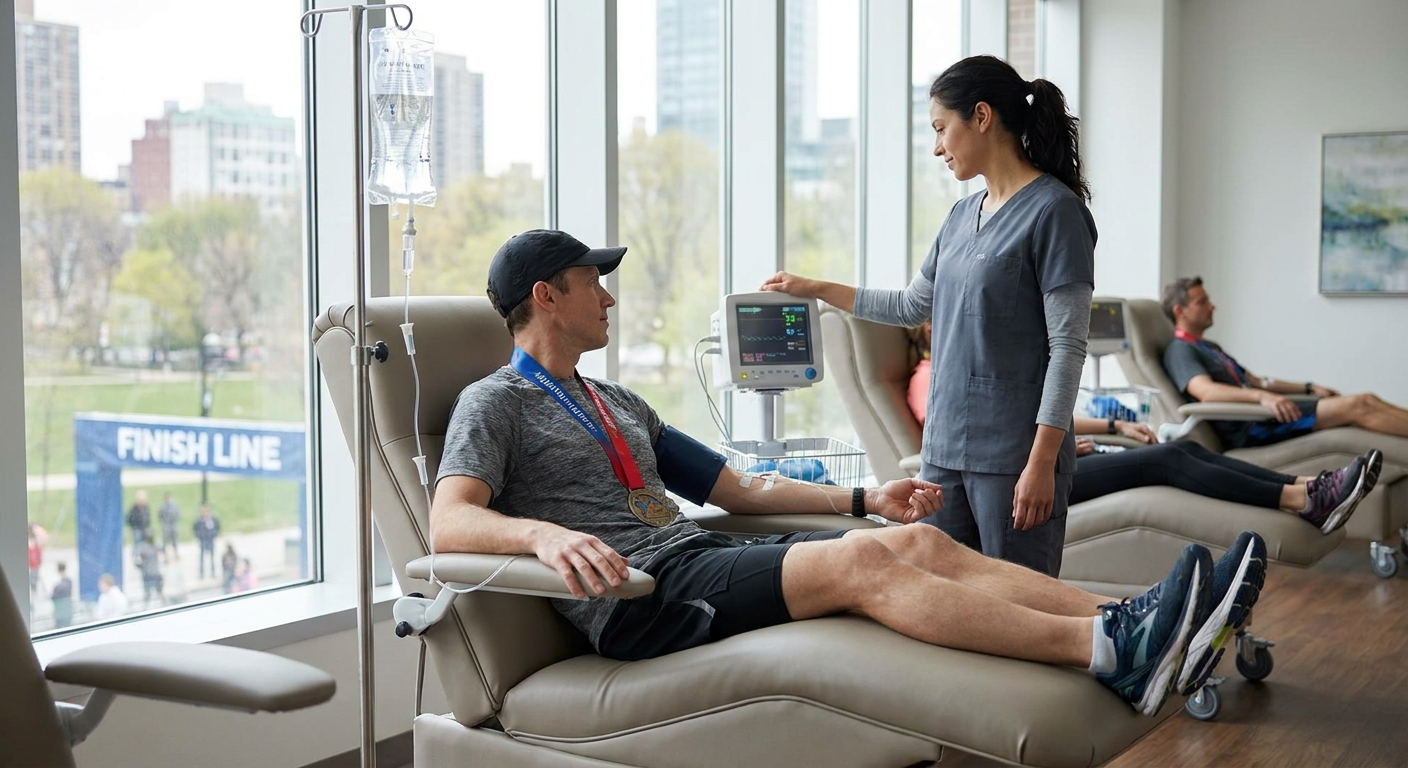
IV hydration is a medical treatment, not a routine requirement before or after a marathon. Runners should start with an individualized hydration and recovery plan and seek clinical assessment when symptoms suggest illness, significant dehydration or another problem.
TL;DR
- An infusion is not a proven shortcut to better race performance.
- Oral hydration and ordinary recovery remain appropriate for many runners.
- Post-race symptoms can require urgent assessment rather than more fluid.
- Infusion Center of NJ offers physician-led assessment, not guaranteed faster recovery.
Why this matters
Fatigue, nausea and muscle symptoms after running do not establish what fluid or electrolyte treatment you need. Too much fluid can also be harmful. Do not assume the answer is an IV simply because the event was long or demanding.
For persistent nonurgent concerns, request a physician consultation. Infusion Center of NJ provides outpatient assessment in Clifton and Tenafly. Race-day emergencies belong with event medical staff or emergency services, not a routine outpatient booking.
Assess symptoms before treatment
Recognize urgent warning signs
Confusion, collapse, chest pain, severe breathlessness or seizures require emergency assessment. After exertion, heat illness and fluid or electrolyte disturbances can produce overlapping symptoms. Do not self-diagnose dehydration or keep drinking large amounts while delaying care.
Review the full training picture
Describe recent training, meals, sleep, medicines, supplements, fluid intake and any prior medical problems. Persistent fatigue can have several causes. A physician decides whether examination or laboratory testing is appropriate before recommending treatment.
Reserve iron treatment for a supported indication
Being a runner does not establish iron deficiency. Blood counts and iron studies are interpreted in context; a single symptom or an isolated number should not drive treatment selection. Do not start iron or arrange an infusion to improve performance without clinical assessment.
Check sport rules independently
Competitive athletes should review the rules of their governing body before any elective infusion. A treatment being offered by a clinic does not establish that it is permitted in a particular sport or competition.
Compare the routes
| Approach | Best for | Limitation |
|---|---|---|
| Oral fluids, meals and rest | Routine recovery when tolerated | Not a substitute for medical care when seriously unwell |
| Outpatient evaluation | Persistent nonurgent symptoms | Does not guarantee a treatment recommendation |
| Clinician-directed IV treatment | A specific medical need for that route | Carries risks and is not a routine performance intervention |
IV treatment can cause infection, vein irritation, reactions or fluid and electrolyte complications. No universal pre-race buffer, post-race treatment window or recurring infusion schedule applies to every runner.
FAQ
Do I need IV fluids after every marathon?
No. A marathon does not automatically create a medical need for IV hydration.
Will IV vitamins improve my race time?
A performance improvement is not established or guaranteed by receiving an elective nutrient infusion.
Is more fluid always better after running?
No. Excess fluid can also cause harm, and symptoms require context rather than automatic fluid loading.
Does running fatigue mean low iron?
No. Your clinician decides whether testing is needed and interprets the results with your history.
Can I schedule an infusion before a race?
Discuss the medical indication and competition rules with your clinician before considering elective treatment.
Which symptoms need emergency care?
Confusion, collapse, seizures, chest pain or severe breathlessness need immediate assessment rather than routine clinic booking.
One last thing
The useful recovery plan is the one matched to your condition, not the longest ingredient list. An evaluation can appropriately end with no infusion.
Locations and appointments
Clifton: 842 Clifton Ave, Suite 4, Clifton, NJ 07013. Tenafly: 111 Dean Dr, Suite 1S, Tenafly, NJ 07670.
Discuss nonurgent running-related symptoms
Request an appointment · Call (973) 272-6220
Related guides
Medical review: Jeffrey A. Weiss, MD, Board-Certified Internal Medicine Physician — Founder & Medical Director, Infusion Center of NJ.
Educational information only; not individualized medical advice. Results vary.