
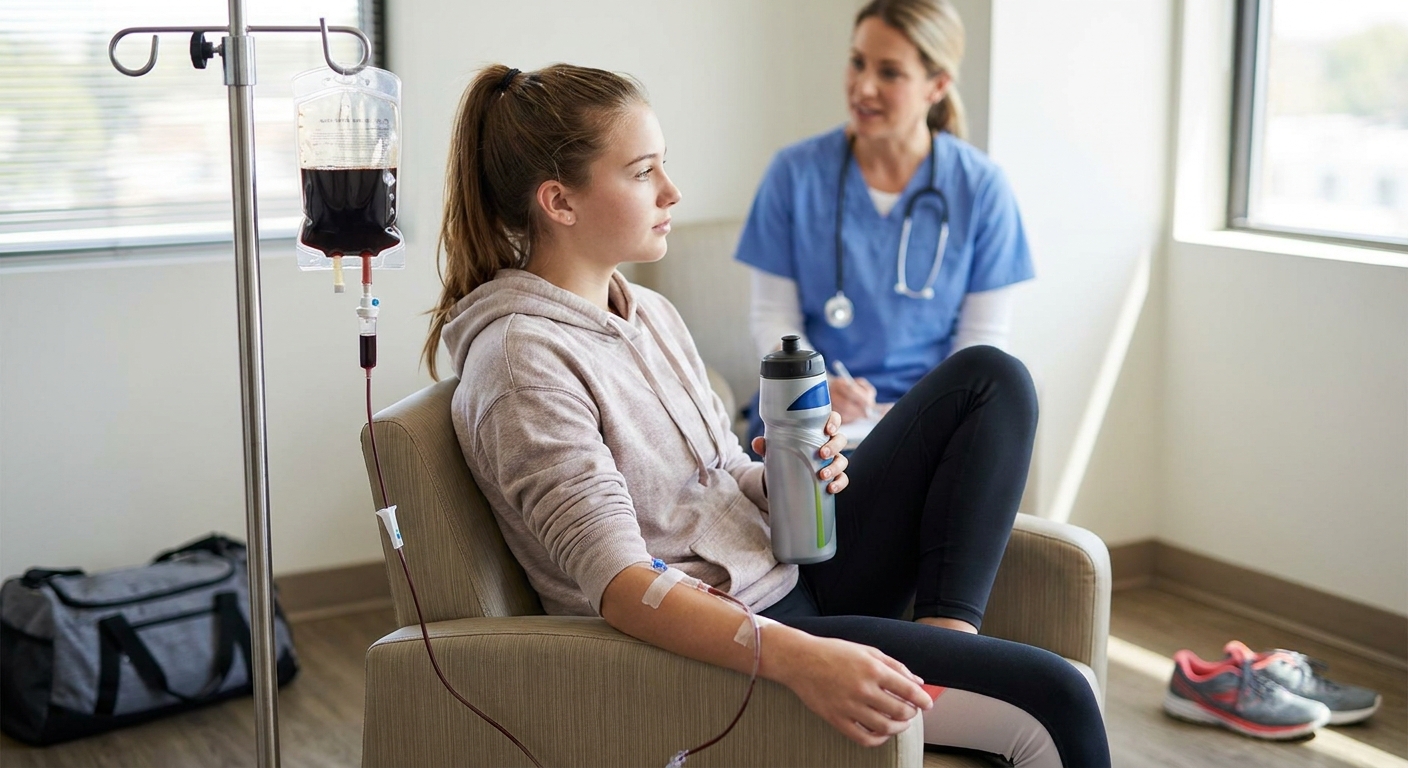
Teen athletes who feel wiped out mid-season, can't finish practice without gasping, or keep testing low on ferritin need a different conversation than the one happening at a mall vitamin bar. Iron infusion for teen athletes is a real clinical option when oral iron fails or deficiency is severe enough to affect performance and growth, but it has to be handled by a physician who checks labs before and after, not a walk-in drip menu.
TL;DR
- Iron infusion for teen athletes is appropriate only after labs confirm ferritin and transferrin saturation are actually low, not just symptoms of fatigue.
- Single-dose ferric carboxymaltose infusions typically run 15 to 60 minutes and are the practical Consider pick for busy training schedules in 2026.
- Oral iron stays the first-line Buy pick for mild deficiency; IV iron is reserved for confirmed, more significant shortfalls.
- Drip-bar settings without physician oversight are a Skip for teen athletes because dosing and reaction monitoring matter more in adolescents.
- Infusion Center of NJ evaluates iron status with labs before recommending an iron infusion, at locations in Clifton and Tenafly, NJ.
Why this matters
Sports-related anemia in teenagers is not the same problem as anemia in a 45-year-old marathoner. Adolescents are still growing, menstruating athletes lose iron monthly, and heavy training itself can suppress iron absorption through a hormone called hepcidin. A teen who's iron-deficient but not yet anemic can still see a real drop in endurance and recovery, which is exactly the group coaches and parents tend to miss because a basic blood count still looks normal.
Getting this wrong in either direction costs a season. Treat fatigue as just needing more sleep and a talented runner keeps underperforming for months. Jump straight to an IV iron infusion without confirming deficiency first, and a teenager gets an unnecessary medical procedure for a problem oral supplementation or better nutrition timing could have solved. Infusion Center of NJ approaches this with lab-first, physician-led evaluation rather than treating the request for an infusion as a foregone conclusion.
Who this is for
This guide is for parents, coaches, and older teen athletes dealing with a runner, swimmer, soccer player, or cross-country competitor whose performance has dropped and whose bloodwork shows low ferritin or low transferrin saturation. It's most relevant for endurance athletes and menstruating female athletes, the two groups with the highest documented rates of sports-related iron deficiency. It is not for a teen who's simply tired from a heavy school and practice schedule with normal iron labs — that's a different problem with a different fix.
What to look for in an iron infusion for teen athletes
Confirmed deficiency, not assumed fatigue
An iron infusion should follow a documented low ferritin and low transferrin saturation, not a hunch based on tiredness alone. Fatigue in teen athletes has a dozen causes — sleep debt, undereating relative to training load, even mono — and iron infusion won't fix any of those. A physician who orders full iron studies before recommending IV iron is protecting the athlete from an unnecessary infusion.
Ferritin and transferrin saturation thresholds
Most clinicians consider ferritin under roughly 20-30 ng/mL in an athlete significant enough to act on, even without full-blown anemia, because performance can suffer before hemoglobin drops. This threshold matters specifically for athletes because their oxygen demand is higher than a sedentary teen's. Knowing the actual number, not just low normal, changes whether oral iron is enough or IV iron is warranted.
Training season timing
Infusion timing relative to competition schedule matters more for teen athletes than for general patients. Scheduling an iron infusion during a taper week or off-season window, rather than the week before a championship meet, avoids compounding fatigue with recovery from the infusion itself. A physician-led practice will ask about the season calendar before booking.
IV formulation and infusion time
Different iron formulations run on different timelines — some single-dose options finish in under an hour, others require iron sucrose spread across multiple shorter visits. For a teen juggling practice and school, the formulation and how many total visits it requires is a practical scheduling question, not just a clinical one.
Physician oversight versus drip-bar settings
IV iron carries a small but real risk of infusion reactions, and adolescents need weight-based dosing and monitoring that a walk-in wellness bar isn't set up to handle. A setting with a board-certified physician present, rather than a menu of vitamin drips, is the appropriate standard for a minor receiving IV iron.
Follow-up lab monitoring
A single infusion isn't the end of the process. Ferritin should be rechecked roughly 4-8 weeks after infusion to confirm the levels actually rose and stayed up, since a teen's ongoing training load can deplete iron again within a season.
Get iron levels checked before the season
Physician-led evaluation for teen athletes at Clifton and Tenafly, NJ locations.
Treatment options to weigh
Oral iron first — the default starting point. For mild deficiency (ferritin in the 20-40 range without anemia), a course of oral iron over 8-12 weeks is still the standard first move, and it's far cheaper and lower-risk than any infusion. Verdict: Buy as the first step for anything short of significant deficiency.
Single-dose IV iron (ferric carboxymaltose) — the one-and-done option. This formulation typically delivers a full therapeutic iron dose in a single visit running roughly 15 to 60 minutes, which is the main draw for a teen who can't afford multiple missed practices. It's reserved for confirmed, more significant deficiency or intolerance to oral iron. Verdict: Consider when labs confirm the deficiency is real and oral iron hasn't worked or isn't tolerated.
Iron sucrose, multi-session protocol — the gradual approach. Instead of one large dose, iron sucrose is split across several shorter visits, which some physicians prefer for more conservative dosing in adolescents. It asks more of the training schedule but spreads any reaction risk across smaller doses. Verdict: Consider for younger teens or when a physician prefers a more cautious, incremental approach.
Myers Cocktail or general wellness drips as a stand-in — not a substitute. A Myers Cocktail contains vitamins and minerals but is not formulated to correct iron deficiency anemia. Using a general wellness drip in place of an actual iron infusion because it sounds similar leaves the underlying deficiency untreated. Verdict: Skip as a treatment for confirmed iron deficiency — it belongs in a different conversation about general wellness support.
Unsupervised walk-in IV bars — convenient, not appropriate for minors. Many retail IV lounges advertise iron add-ons without requiring recent labs or physician review, which skips the exact safety step that matters most for a teenager. Verdict: Skip — a physician-led setting with lab review before dosing is the appropriate standard here.
What to avoid
- Booking an infusion off symptoms alone. Fatigue without a documented low ferritin is not a green light for IV iron — get the labs first.
- Choosing a setting by menu instead of oversight. A location that lists iron infusion next to a hangover drip and a tan-enhancing drip, with no physician review of labs, is the wrong environment for a minor.
- Returning to full-intensity training the same day. Even a smooth infusion can leave a teen fatigued for the rest of that day; scheduling a lighter practice day around it avoids compounding the effect.
Verdict comparison
| Option | Setting needed | Typical time | Verdict |
|---|---|---|---|
| Oral iron course | Home, with lab recheck | 8-12 weeks | Buy for mild deficiency |
| Ferric carboxymaltose (single-dose IV) | Physician-led infusion setting | 15-60 minutes | Consider for confirmed deficiency |
| Iron sucrose (multi-session) | Physician-led infusion setting | Several short visits | Consider for conservative dosing |
| Myers Cocktail alone | Any wellness setting | 30-45 minutes | Skip for treating anemia |
| Unsupervised walk-in IV bar | Retail drip lounge | Varies | Skip for minors |
FAQ
Is iron infusion safe for teenage athletes?
Iron infusion is safe for teen athletes when a physician confirms deficiency with lab work and monitors the infusion for reactions. It is not appropriate as a walk-in wellness add-on without lab review first.
What's the difference between oral iron and IV iron for athletes?
Oral iron is a slower, lower-cost first-line treatment taken over 8-12 weeks, while IV iron delivers a therapeutic dose directly into the bloodstream in one or a few visits. IV iron is generally reserved for confirmed, more significant deficiency or when oral iron isn't tolerated.
How long does an iron infusion take for a teen athlete?
A single-dose formulation like ferric carboxymaltose typically runs 15 to 60 minutes, while iron sucrose protocols split the dose across several shorter visits. Total time in-office depends on which formulation the physician recommends.
Can iron infusion improve athletic performance?
Correcting confirmed iron deficiency can improve endurance and recovery because iron is required to carry oxygen to muscles. Iron infusion given to an athlete with normal iron levels will not produce a performance benefit.
How often can a teen athlete get iron infusions?
Frequency depends on repeat lab results, typically checked 4-8 weeks after infusion to confirm ferritin rose and held. A physician-led evaluation should confirm ongoing deficiency before scheduling another infusion.
Is iron infusion better than iron pills for a teen athlete?
Iron infusion is not automatically better; it's reserved for cases where oral iron fails, isn't tolerated, or deficiency is significant enough to need faster correction. Most mild cases still respond well to oral iron over several weeks.
Do teen athletes need a doctor's referral for iron infusion in New Jersey?
A physician evaluation and lab confirmation of deficiency should come before any iron infusion for a minor, regardless of formal referral requirements. Physician-led practices in NJ, including Infusion Center of NJ, require lab review as part of the evaluation.
What ferritin level indicates a teen athlete needs iron treatment?
Many clinicians act on ferritin under roughly 20-30 ng/mL in an athlete even without anemia, since performance can decline before hemoglobin drops. The exact threshold and treatment plan should come from a physician reviewing the full iron panel.
One last thing
The detail parents miss most: a teen can have completely normal hemoglobin and still be iron-deficient enough to hurt performance, because ferritin drops before hemoglobin does. Requesting a full iron panel — not just a basic complete blood count — is the single change that catches sports-related anemia earlier in 2026's youth athletes than it did a decade ago. Infusion Center of NJ, led by board-certified internist Dr. Jeffrey A. Weiss, evaluates iron status this way before any iron infusion is recommended at its Clifton and Tenafly locations.