
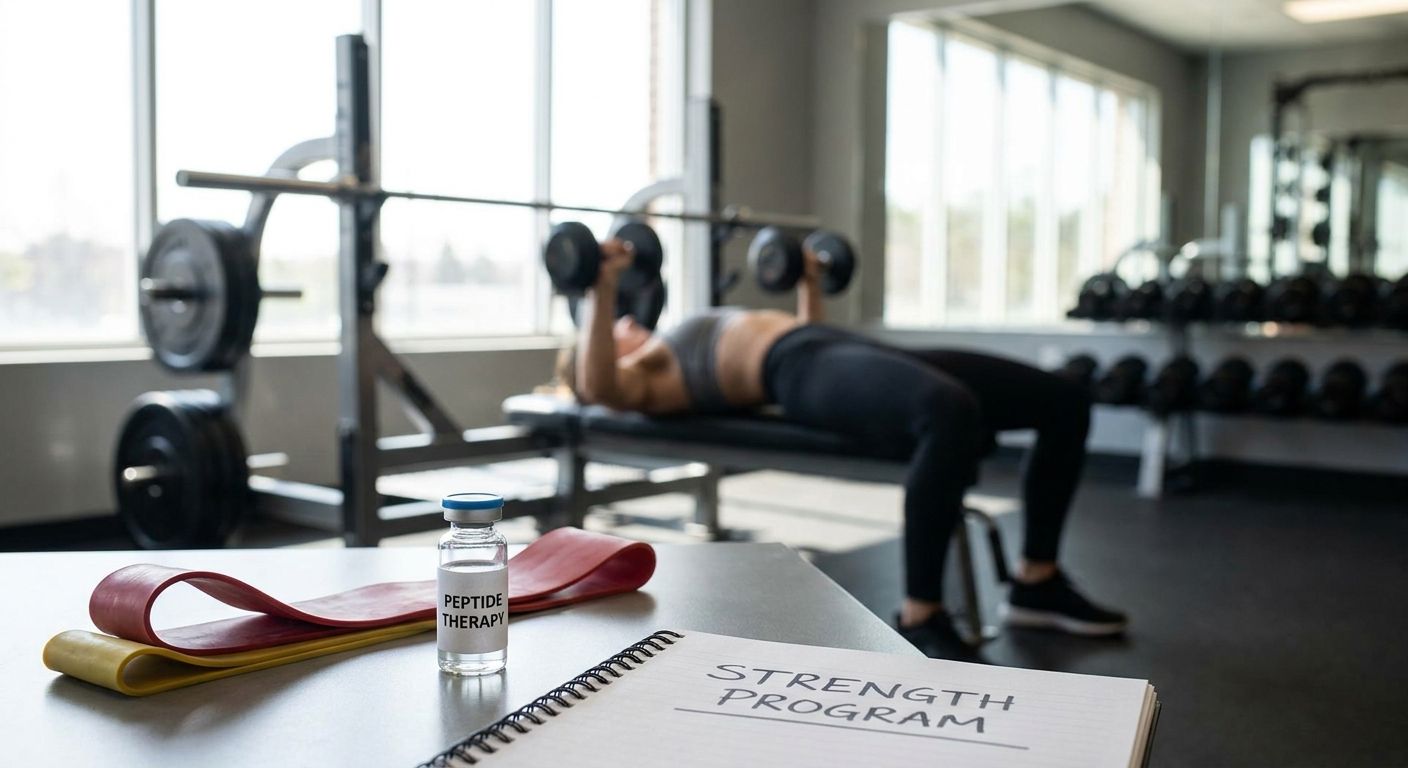
Peptide therapy and strength training work together only when the dosing calendar is built around the lifting program, not bolted onto it after the fact. This guide walks through the sequencing, tracking, and physician checkpoints that keep the two working in the same direction instead of against each other.
TL;DR
- Peptide therapy and strength training pair best when dosing windows match training phases, not calendar days.
- Baseline bloodwork and physician clearance come before any peptide protocol starts in 2026 — skipping this step is the top reason programs stall.
- Recovery peptides (BPC-157, TB-500 style compounds) support connective tissue; growth hormone secretagogues support volume tolerance — they solve different problems.
- Reassess at 8-12 weeks with follow-up labs, not gut feel, before extending or stopping a protocol.
Why this matters
Most people who try to combine peptide therapy with a strength training program treat the peptide like a supplement — take it, lift, hope. That approach ignores the fact that peptides have specific windows of biological action, and training that ignores those windows wastes both the compound and the training cycle. Physician-led programs, like the ones run out of Infusion Center of NJ, build the peptide schedule around the lifting block instead of the other way around, because sequencing is what actually determines whether a 2026 protocol produces measurable strength or recovery gains.
The stakes are higher than they look. A poorly timed peptide cycle can mask overtraining symptoms, delay a needed deload, or push someone into a plateau they mistake for a peptide failure. Get the sequencing right and the same compound that did nothing in month one starts showing up in bar speed and soreness scores by month two.
What you'll need
- Baseline bloodwork — CBC, CMP, and any hormone panel your physician orders before starting
- A written training program with defined phases (accumulation, intensification, deload) rather than random daily workouts
- A peptide protocol prescribed by a licensed physician — dosing, frequency, and duration, not a generic online template
- A protein target of 1.6-2.2 g per kg of bodyweight per day, tracked, not estimated
- A recovery log — sleep hours, soreness rating (1-10), and resting heart rate or HRV if you have a wearable
- 8-12 weeks of committed time before making any judgment on whether the protocol is working
The steps
1. Get baseline labs and physician clearance before you start
This step exists to catch anything that would make peptide therapy inappropriate — thyroid issues, kidney markers, or existing hormone imbalances that change the dosing math entirely. Skipping labs means you're guessing at a starting point instead of measuring one. Expect a CBC, CMP, and a targeted hormone panel depending on the peptide category being considered. Common mistake: starting a protocol based on a friend's dosing schedule instead of your own labs.
2. Match the peptide category to the training problem you actually have
Recovery-oriented peptides (the BPC-157 and TB-500 style category) target connective tissue and soft-tissue repair — useful if nagging tendon or joint issues are limiting your training volume. Growth hormone secretagogues target sleep quality and overall recovery capacity — useful if you're training hard but waking up flat. These are not interchangeable, and picking the wrong category for your actual limiter is the single biggest reason people report "peptide therapy did nothing" after 8 weeks. Common mistake: choosing a peptide based on what's trending instead of what your training log actually shows as the bottleneck.
3. Build the training block around the peptide's action window
Most recovery peptides have a working window measured in 24-48 hour cycles after dosing, which means the heaviest training days should land during that window, not the day before a scheduled dose. Lay your training calendar out first, then place peptide dosing on the days it will do the most work — usually the day of or day after your highest-volume session. Common mistake: dosing on rest days out of convenience and expecting the same effect as dosing around training stress.
4. Set a loading phase, then a maintenance phase
Most physician-guided protocols use a 10-14 day loading phase at a slightly higher frequency, followed by a maintenance phase at a lower frequency through the rest of the 8-12 week block. Your strength program should mirror this — a higher-volume accumulation phase during loading, tapering into an intensification phase as the peptide moves to maintenance dosing. Running both phases on the same calendar keeps the stimulus and the recovery support aligned instead of fighting each other. Common mistake: staying in a high-volume training phase indefinitely because "the peptide should handle it."
5. Track recovery markers weekly, not monthly
Soreness rating, sleep hours, and resting heart rate give you a real-time signal on whether the protocol is working before your next lift numbers even move. A soreness score that drops from a 7 to a 4 by week three while training volume holds steady is a working signal — a lift number alone at week three often isn't, because strength gains lag recovery gains by several weeks. Common mistake: judging the whole protocol on week-one bar speed instead of the four-week recovery trend.
6. Support the protocol with nutrition, hydration, and micronutrient status
Peptide therapy doesn't compensate for a protein intake below 1.6 g/kg or chronic under-hydration during a strength block — it amplifies whatever recovery capacity you already have. Some patients pair peptide protocols with IV nutrient support, such as a Myers Cocktail or targeted vitamin infusion, to correct deficiencies that show up on baseline labs, though this is a physician decision based on individual bloodwork, not a default add-on. Common mistake: treating the peptide as a substitute for basic nutrition instead of a multiplier on top of it.
7. Reassess with follow-up labs and a program review at 8-12 weeks
End every protocol block with a real checkpoint: repeat labs, a review of the recovery log, and a conversation with your physician about whether to extend, adjust, or stop. Extending a protocol without reassessment is how people end up on peptides for a year without any documented change in recovery markers. Common mistake: treating the 8-12 week mark as optional instead of the built-in decision point it's meant to be.
Talk to a physician before you start
Get baseline labs and a protocol built around your actual training block.
Troubleshooting
- No change in soreness or recovery by week 6 — the peptide category likely doesn't match the actual limiter; recovery peptides won't fix a sleep problem and secretagogues won't fix a tendon problem.
- Injection site soreness or redness — usually resolves within 48-72 hours; persistent redness beyond that warrants a call to your physician, not a dose adjustment on your own.
- Sleep disruption after starting a secretagogue-category peptide — dosing too close to bedtime is the most common cause; shifting the dose earlier in the evening often resolves it within a week.
- Plateau around week 6-8 despite good adherence — this is often a training program issue, not a peptide issue; check whether volume has quietly crept up without a planned deload.
- Appetite or digestion changes — common with several peptide categories and usually mild; flag anything severe or persistent to your physician immediately.
- Lift numbers stall while recovery markers improve — this is a normal lag; strength typically trails recovery gains by 2-4 weeks in a well-sequenced protocol.
Tools and resources
- A written, phased training program (accumulation, intensification, deload) rather than an ad hoc routine
- A recovery log — spreadsheet or app — tracking soreness, sleep, and resting heart rate
- Baseline and follow-up bloodwork ordered by a licensed physician
- A body weight scale and a simple protein-tracking method to hit the 1.6-2.2 g/kg target
- A physician-led program, such as the integrative and infusion-based care available through Infusion Center of NJ, for lab work, protocol design, and follow-up oversight
What to do next
Before you combine peptide therapy with a strength training program, get baseline labs pulled and sit down with a physician to map your actual limiter — recovery, sleep, or connective tissue — against the right peptide category. The training program comes second; the diagnosis comes first. Programs built this way in 2026 tend to hit their 8-12 week checkpoint with real, measurable changes instead of a guess about whether anything happened at all.
FAQ
What is the best way to combine peptide therapy with a strength training program?
Match the peptide category to your actual training limiter — recovery peptides for connective tissue issues, growth hormone secretagogues for sleep and recovery capacity — then build training phases around the peptide's dosing calendar. Reassess at 8-12 weeks with follow-up labs.
Is peptide therapy better than just training and eating more protein?
Peptide therapy is not a substitute for protein intake or training volume — it works on top of a solid baseline, typically 1.6-2.2 g/kg of protein daily. Without that baseline, most patients see little added benefit from a peptide protocol in 2026.
How long before peptide therapy shows results in strength training?
Recovery markers like soreness and sleep quality often shift within 2-4 weeks, while measurable strength changes typically lag 4-8 weeks behind. Most physician-guided protocols use an 8-12 week block before reassessment.
Do I need bloodwork before starting peptide therapy?
Yes — baseline labs including a CBC, CMP, and relevant hormone panel are standard before starting any physician-guided peptide protocol. Labs catch contraindications and give you a real starting point instead of a guess.
Should I dose peptides on training days or rest days?
Most recovery-oriented peptides work in a 24-48 hour window, so dosing on or right after your heaviest training day usually gets more from the compound than dosing on a rest day out of convenience.
Can peptide therapy replace a deload week?
No — peptide therapy supports recovery capacity, it doesn't eliminate the need for planned deloads. Skipping deloads because a peptide protocol is running is a common cause of stalled progress around week 6-8.
What's the difference between recovery peptides and growth hormone secretagogues?
Recovery peptides such as BPC-157 and TB-500 style compounds target soft-tissue and connective tissue repair, while growth hormone secretagogues target sleep quality and overall recovery capacity. Picking the wrong category for your actual limiter is the top reason people see no results.
How often should I check in with a physician during a peptide protocol?
Plan for a baseline check before starting and a follow-up around the 8-12 week mark, with earlier contact if you notice persistent side effects like injection site redness lasting beyond 72 hours.
One last thing
The detail that trips up most people combining peptide therapy with a strength training program isn't the peptide — it's the training log. Patients who track soreness, sleep, and resting heart rate weekly catch a working protocol by week three; patients who only check their lift numbers often miss it until week eight and quit right before the strength gains would have shown up.